
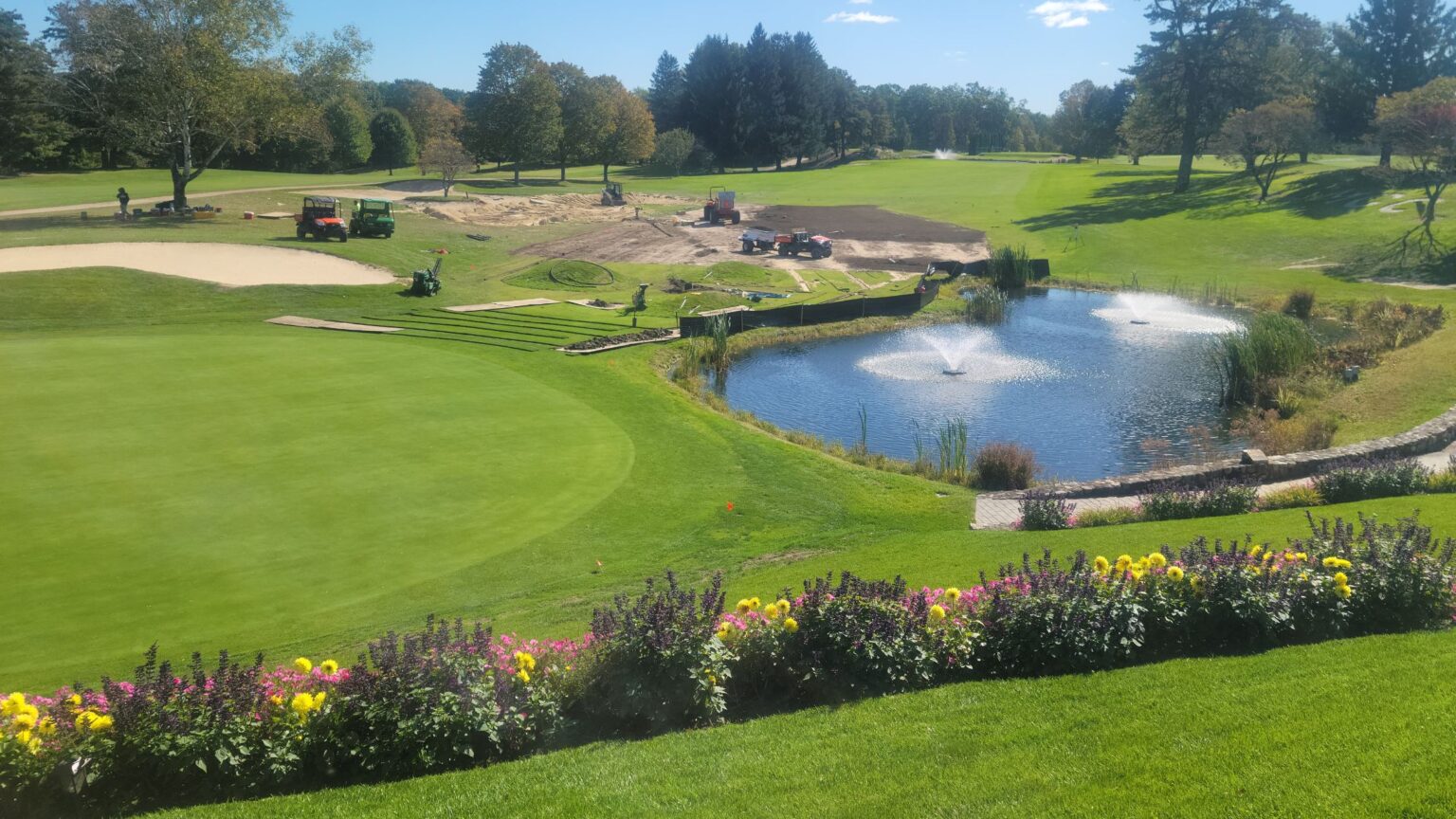
Golf Course Construction Built From the Drainage Up
Turf Rehab builds and rebuilds greens, bunkers, tees and fairways for private clubs, public courses and resorts. Every hole we touch starts with one question: where is the water going to go?
Years combined experience
Years of 2" slit drainage
States served
Trusted on the ground at
Oakmont CCChicago GCPortland CCNorth Shore CCThe Tree FarmWayzata CCHyannisport ClubThe Apawamis ClubHuntingdon Valley CCWoodhill CCBiltmore Forest CCBryn Mawr CC
Construction
Golf Course Construction From a Crew That Specializes in Water
Turf Rehab is a golf course construction and drainage contractor based in Cambridge, NY. We build and rebuild the parts of a course that take the most abuse: greens, bunkers, tees, fairways and approaches. What sets our golf course construction work apart is where we start. Before we shape a single surface, we figure out how water will move across it and through it, because water is what ruins most new construction within a few seasons.
Our President, Mark Rowan, has 17 years of golf course construction experience, and his specialty is designing and building drainage systems. Mark Luckhardt, our Turf Consultant, developed the 2-inch slit drainage process more than 35 years ago. Between the two of them, that's more than 50 years spent fixing saturated turf on golf courses and athletic fields. When you hire us to build, you get a crew that has spent decades looking at what goes wrong after other people build.
We run our own crew with equipment set up for golf course work. The same people who walk your site on day one are the people on the machines. That matters on a golf course, where the superintendent needs to know who is on the property, what they're doing and when they'll be out of the way.
You can read more about how the company started on our About Turf Rehab page, or meet Mark Rowan directly.

What Our Golf Course Builders Handle
Most clubs don't need a brand new 18 holes. They need a few greens rebuilt, a set of bunkers redone, tees leveled and fairways that stop holding water. Our golf course builders handle any of those pieces on their own or as part of a larger renovation.
Greens
We build and rebuild greens with our own modified method instead of the USGA or California method. 2-inch slit drainage pipe goes into a greens subgrade 8 to 12 inches deep, and the trenches are backfilled and built up with 8 to 12 inches of a homogeneous sand rootzone that leans to the organic side, such as a 70% sand and 30% organic blend. The green is then grassed to the club's specifications. We also repair existing USGA and California greens. Our golf green construction page walks through the method in detail.
Bunkers
Bunkers take a beating from every storm. We build new bunkers, renovate old ones, rebuild the drainage under the sand and remove bunkers a club no longer wants. At North Shore CC in Wisconsin, our crew finished a bunker removal project on a timeline that weather had squeezed tight, and superintendent Joel Larsen said the work was precisely planned and carried out. See bunker construction and renovation for how we handle sand, liners and drainage.
Tees
We build new tees and restore old ones. Tee work usually means regrading, laser leveling and fresh grassing so the surface is flat, drains properly and spreads traffic out. A level tee lets divots heal faster and keeps players from crowding into the one good spot. Our tee construction and leveling page covers it step by step.
Fairways, Approaches and Surrounds
A lot of fairway problems come from grading. Small errors in the surface create pockets where water collects, and tight or compacted soil holds that water longer. We regrade fairways, approaches and green surrounds so water sheds off the playing surface instead of sitting on it, then add subsurface drainage in the low areas that need it. Surface grades and subsurface drainage work together, so we plan them together.
Drainage, Mapping and Grassing
Drainage isn't an add-on in our construction work. It goes in as part of the build, whether that's 2-inch slit drainage, conventional perforated pipe, larger collector lines or ties into the drainage you already have. We GPS-map the lines we install so your staff knows exactly where they are years from now. Then we finish with grassing and sod work so the area can grow in on a realistic schedule. You can see how we plan these systems on our golf course drainage design page.
Our process
How a Golf Course Construction Project Runs
Construction on a working golf course has a lot of moving parts. Members still want to play, the maintenance staff still has to mow, and the weather rarely cooperates. We follow the same six steps on every project so you always know what's happening next.
Site Visit and Assessment
We walk the holes with your superintendent. We look at where carts steer around, where shoes pick up mud, where turf thins out every year and where the crew stays away after a storm. Those patterns tell us more than any map.
Soil Profile Review
We dig into the soil to see what's there. Heavy clay moves water very differently from sandy ground, and that changes everything about how a green, tee or fairway should be built. We also check existing drainage and surface grades.
Layout and Design
We lay out the work using GPS, and we design it around how your staff maintains the course. Your crew has to be able to mow, topdress and aerify over everything we build, so the layout accounts for that from the start.
Cost Breakdown by Area
You get pricing broken out by area: each green, each bunker complex, each tee, each fairway section. That lets a green committee see where the money goes and decide what to do now and what to phase into later seasons.
Construction and Installation
Our own crew does the work. We schedule around the golf calendar and adjust when severe weather hits. Nick Roth, superintendent at The Tree Farm in South Carolina, pointed out how quickly our crew adjusted after storms during his project.
Final Inspection
We walk the finished work with you before we leave. We check grades, drainage outlets and surfaces, and we hand over the mapping so your staff has a record of what went in the ground.
Working With Golf Course Architects and Superintendents
Many of our construction projects start on an architect's drawings. We're comfortable building to someone else's plan, and we bring a drainage point of view to it. If we see a spot where a green surround will collect water or a bunker floor sits lower than its outlet, we'll say so before the shaping starts, while it's still cheap to change.
Superintendents are the people we work with every day on site. We plan around your maintenance schedule, tournaments and member events. We tell you which holes we'll be on and for how long, and we keep the work area clean so the rest of the course stays in play. Clubs like Portland CC in Maine have had us back for more than one fall, and superintendent J.B. Christie described our staff as professional, detailed and hardworking.
Owners and green committees get clear numbers. The cost breakdown by area and the GPS layout give your board something concrete to review instead of a single lump-sum figure. If you want to start the conversation, send a Request a Project Review with your plans or photos.
Why Golf Course Construction Starts With Drainage
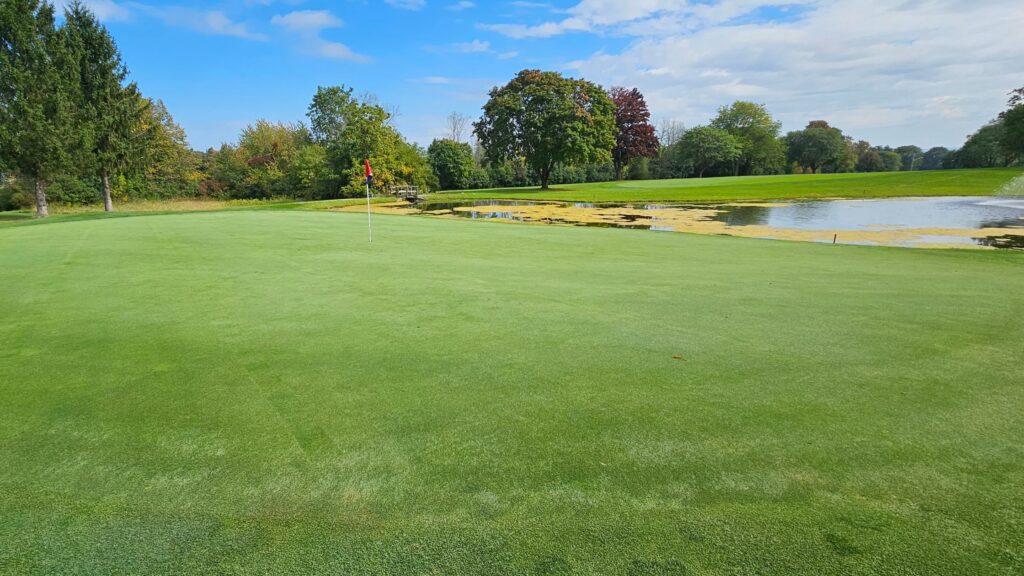
A new green or fairway can look perfect on opening day and still fail within three years if water has nowhere to go. When water sits in the top of the soil, roots stay shallow, turf thins out, mowers leave ruts and carts tear up the surface. Players notice it as soft fairways, plugged lies and greens that never firm up. Superintendents notice it as the same bad spots every single season.
Construction is the cheapest time to get drainage right. The ground is already open, the grades are being set and nothing is growing yet. Adding drainage to a finished hole later means cutting through new turf and working around play. We build the drainage into the job from the first day so you don't pay for it twice.
Done right, good drainage gets puddles off quickly and lets surfaces firm up sooner after rain without going rock hard. Roots grow deeper, which means thicker turf with better color. You lose less turf after heavy storms, and you can set greens and fairways firmer and faster when you want to. That's what our golf course construction is built around.
Results
Proof From Courses We've Worked On
Most of what we hear back comes from the superintendents who watched us work.
After we installed 2-inch drainage in his fairways, he told us "our wettest areas have become our driest," and the club plans to finish the rest of the plan with us.
See every club we've worked with on our project locations page.
A site visit turned into a full master drainage plan. Turf Rehab worked around the club's golf calendar, adjusted after severe weather and installed 2-inch drainage in the fairways.
Nick Roth Golf Course Superintendent, The Tree Farm (SC)
Over two falls of work at Portland, J.B. found the Turf Rehab staff professional, detailed and hardworking. Turf Rehab is now his first call for drainage.
J.B. Christie Golf Course Superintendent, Portland Country Club (ME)
A bunker removal project squeezed into a short, weather-affected window. Joel described the crew as tireless team players who planned the work carefully.
Joel Larsen Golf Course Superintendent, North Shore Country Club (WI)
Brian asked the crew back in November to install as much drainage on the property as possible.
Brian Bromann Ivanhoe Club (IL)
Choosing a Golf Course Construction Company
There are plenty of golf course construction companies, and most of them can move dirt. The questions below will tell you which ones will still look good in five years.
Ask Who Is Actually on Site
Some builders sell the job and sub it out. Ask whether the company uses its own crew and who will be running the work day to day. With Turf Rehab, it's our crew and our equipment.
Ask How They Handle Drainage
Ask what drainage they plan to install, how deep, how far apart and where it outlets. If the answer is vague, the drainage will be too. We can show you the layout, the materials and the outlets before work starts.
Ask for Superintendent References
Superintendents know which contractors left them with problems. Ask to talk to one or two who have had the builder on their property. We're happy to put you in touch with clubs we've worked for.
Ask What Records You'll Get
When the job ends, you should have a map of everything buried on your property. We GPS-map our drainage so future repairs and projects start with facts instead of guesses.
FAQs
Questions we hear most
It depends almost entirely on scope: rebuilding a few greens is a very different number from building 18 new holes. The biggest cost drivers are earthwork, drainage, rootzone sand, irrigation, grassing and how far materials have to travel. We price every project with a cost breakdown by area, so you can see what each green, bunker or fairway costs and phase the work if needed.
Get in touch
Start Your Golf Course Construction Project
The fastest way to get started is to send a project review request. Tell us what you want to build or rebuild, share any plans you have and include photos of problem areas. We answer requests within 24 hours, and we're available every day from 8 AM to 6 PM at (518) 321-0630.
Location11 Ave A, Cambridge, NY 12816
Phone, every day 8 AM to 6 PM(518) 321-0630