
Sports Field Renovation and Drainage Retrofits for Worn-Out Fields
Turf Rehab handles sports field renovation for natural grass fields that have thinned out, compacted or stopped draining. We fix the surface and add drainage to the field you already have, so you get a playable field back without paying for a full rebuild.
Field renovation
When a Field Needs Sports Field Renovation
Fields wear out. Years of games, practices, camps and band rehearsals pack the soil down and wear the grass away in the same places every season. Eventually, aerating and overseeding stop keeping up. That's usually the point where a field needs real renovation instead of more routine care.
Here are the problems we see most on fields that are ready for renovation:
- Thin, patchy turf that doesn't recover after summer or a heavy season
- Soil compaction that keeps water sitting on top
- Wet spots and spongy areas that stay soft for days after rain
- A layer of organic matter built up in the top inch or two that acts like a sponge
- Low spots and uneven grades where water collects
- Shade from nearby trees and poor air movement that weaken the turf
- Uneven irrigation coverage that leaves dry patches next to wet ones
- Heavy wear at entry points, sidelines and team areas
Most fields have more than one of these going on at once, and they feed each other. Compaction slows drainage, wet turf tears more easily, thin turf lets more compaction happen. Sports field renovation breaks that cycle by opening up the soil, fixing the grades and getting healthy grass back on a surface that drains.
Our team has more than 50 years of combined experience fixing saturated, worn turf on golf courses and athletic fields, and our own crew handles the work from start to finish.
Athletic Field Renovation Work We Do
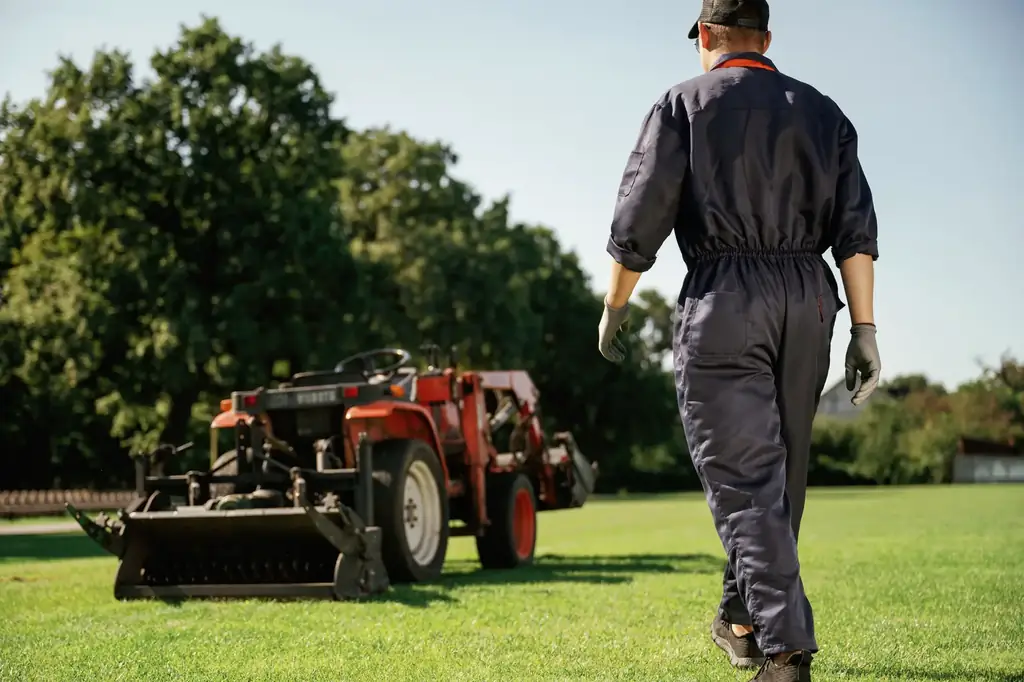
Every field gets a plan built around what's actually wrong with it. Here are the tools we use in athletic field renovation, often in combination.
Regrading Low Spots and Crowns
Over time, fields settle and lose their crown. Low spots form where water collects and turf dies. We rework the surface grades so water sheds off the playing area again. On some fields that means fixing a few low pockets. On others it means restoring the crown across the full width.
Core Aeration and Deep-Tine Work
Compaction is the most common reason a field stops draining. Core aeration pulls plugs from the surface to open it up, and deep-tine work reaches farther down to fracture compacted layers that regular aeration doesn't touch. Together they let water and air back into the rootzone.
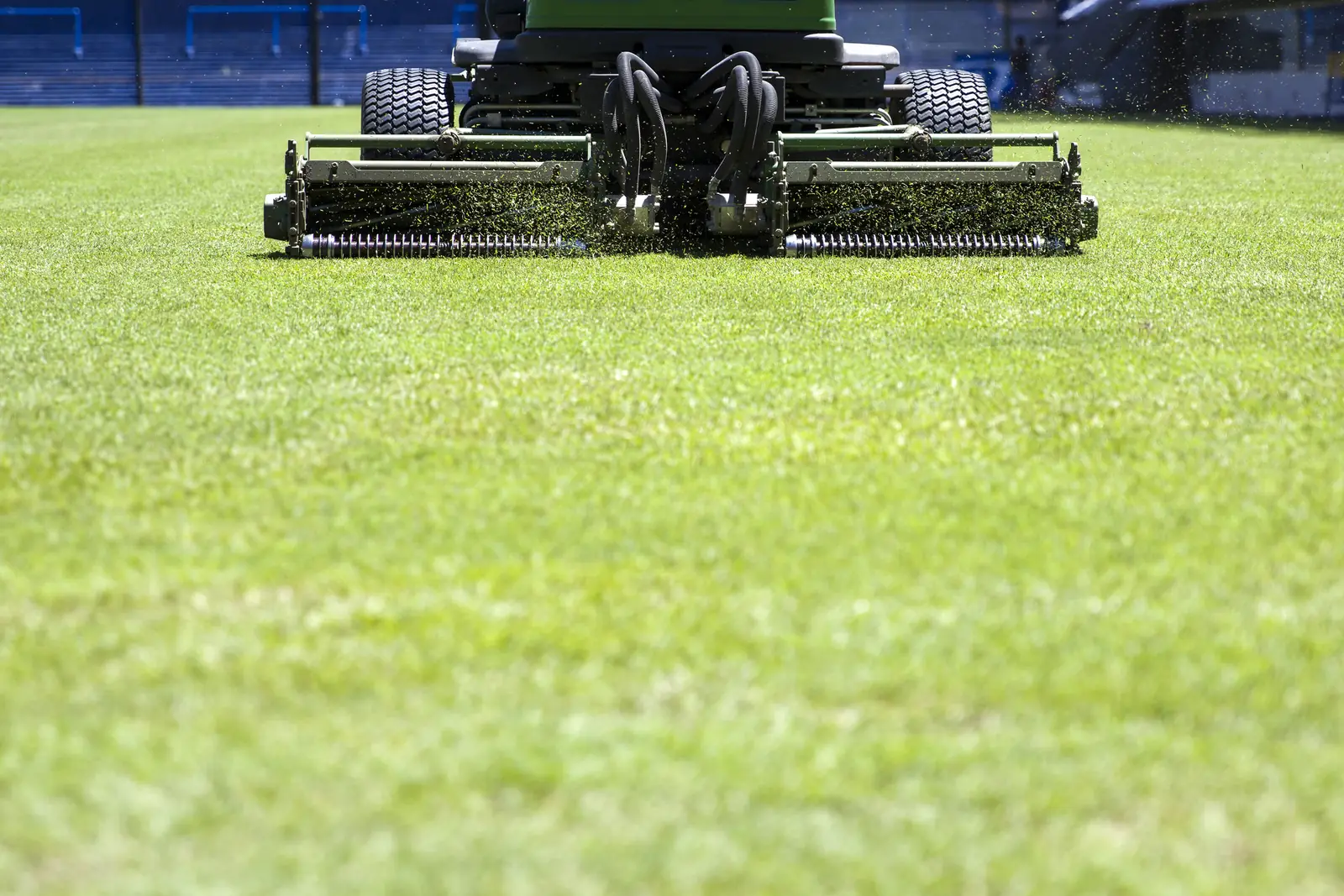
Fraze Mowing and Organic Matter Removal
Fraze mowing uses a machine that strips off the top layer of the field, including the grass, thatch and built-up organic matter. On fields where a spongy layer has formed in the top 1 to 2 inches, fraze mowing is the fastest way to get rid of it. The field regrows from what's left below, without that layer holding water at the surface.
Topdressing
Aggressive topdressing with sand fills aeration holes, smooths the surface and gradually improves how the top of the rootzone drains. Repeated over a renovation, it changes the surface layer the turf grows in, which pays off long after the project is done.
Overseeding and Sod
Once the soil is open and the grades are right, we get grass back on the field. We overseed the general playing area and use sod in high-traffic zones and landing areas that need to be ready fast. The grass species is chosen for your climate, your season and the amount of wear the field takes.
Sports Field Drainage Retrofits on Fields Already in Use
Some fields can't be fixed without drainage. If water is soaking in and then has nowhere to go, renovation alone won't hold. The good news is that drainage can be added to an existing field without tearing it out and starting over. That's what a sports field drainage retrofit is.
We design retrofits around the soil, slope and use of the field, and we install them with our own crew. For more on how subsurface drainage works and the systems we use, see our athletic field drainage page.
Slit Drainage Retrofits
The 2-inch slit drainage process Mark Luckhardt developed more than 35 years ago is well suited to retrofits. A 2-inch microslit pipe goes into a narrow trench backfilled with sand. Because the trenches are narrow, the playing surface is disturbed far less than with wide trench work, and the field recovers faster. Once the cavity around the pipe saturates, the microslits draw water in, which opens pore space so surface water can drain down.
Tying Into Existing Drain Lines
Plenty of older fields already have drain lines that were never mapped or have partly failed. We locate what's there, keep what still works and tie new laterals into sound collector lines where it makes sense. New lines are mapped with GPS so the next person who works on the field knows exactly where everything is.
Baseball Field Drainage
On baseball and softball fields, the outfield is where water hides. Soft pockets return every spring and push early games back. Baseball field drainage retrofits target those pockets with lines that move water out of the outfield, so the field is ready when the season starts.
Soccer Field Drainage
Soccer play covers the whole field, so wear and water problems are spread across the full width. Soccer field drainage retrofits usually need uniform coverage from sideline to sideline, with extra attention to the goal mouths where turf takes the most damage.
Football Field Drainage
Football fields wear hardest between the hashes. That center strip compacts, holds water and loses grass first. Retrofitting drainage through the middle of the field, sometimes with specialty strip drains for high-traffic zones, gives that turf a real chance to recover between games.
Renovate or Rebuild?
Athletic directors and facilities managers ask us this more than anything else. In most cases, renovation with a drainage retrofit costs far less than a full rebuild and gets the field back in play sooner. If the field's grades are close, the soil isn't badly contaminated and the main problems are compaction, thin turf and poor drainage, renovation is usually the right move.
A rebuild starts to make sense when the field has deeper problems: grades that are badly off, a rootzone that can't be fixed with aeration and topdressing, or a program that needs a much higher-performing surface than the current field can ever give. In that case, our sports field construction service covers a full rebuild, including sand-based options.
Either way, you get a cost breakdown by area. That makes it easy to compare the two paths, and it lets you phase a renovation over more than one off-season if the budget calls for it.
Scheduling Renovation Around Your Season
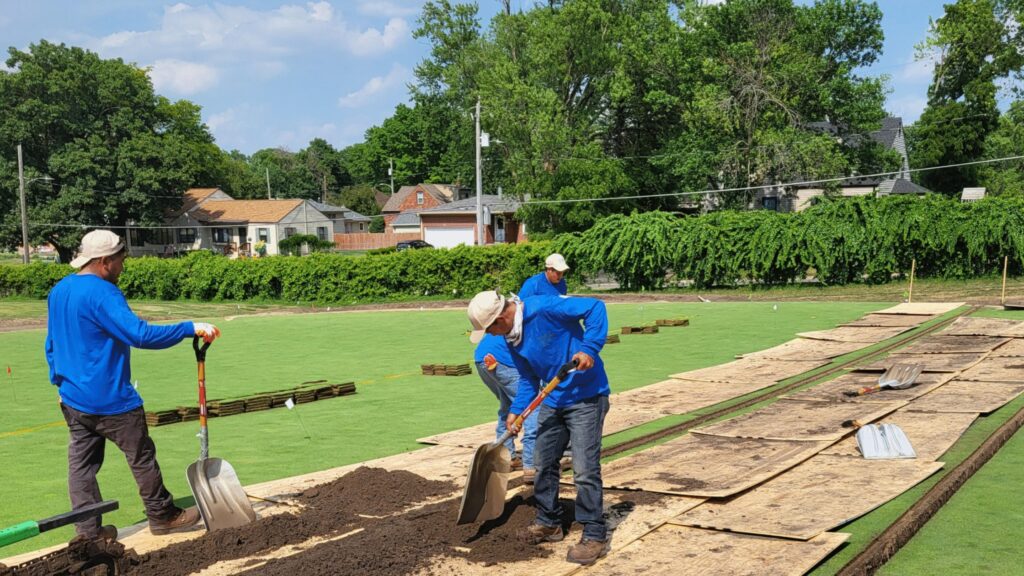
A field renovation only works if the turf has time to grow back before play starts. We set clear timelines and give you a realistic grow-in plan, built around your season. For many fields, that means starting as soon as spring play ends, so the grass has the summer to establish.
We're used to working on tight calendars. On golf courses, our crew works around tee times, and Nick Roth at The Tree Farm in South Carolina noted how quickly we adjusted after severe weather. Athletic field schedules get the same care.
Our process
Our Renovation Process
Site Visit and Assessment
We walk the field with you, looking at worn zones, wet spots and how water moves over and under the turf.
Soil Profile Review
We check soil profiles, existing drainage and surface grades.
Drainage Layout and System Design
If the field needs drainage, we lay it out with GPS mapping and tie it into the renovation plan.
Cost Breakdown by Area
You see the cost of each part of the work and can phase it if needed.
Installation
Our crew handles the regrading, drainage, aeration, fraze mowing, topdressing and grassing.
Final Inspection
We check the finished work and walk you through the grow-in schedule.
FAQs
Questions we hear most
Yes. We retrofit drainage into fields that are already in use, most often with narrow 2-inch slit drainage trenches tied into collector lines. The work can often be scheduled into a short break between seasons, and lines can be added in phases if the budget is tight.
Get in touch
Get Your Field Back in Shape
Send us a project review request with your field location, the sports it hosts and the worn areas and wet spots you're seeing. If you have photos, email them to mmturfrehab@gmail.com. Tell us when your season starts and ends so we can plan around it. We answer requests within 24 hours.
You can also call (518) 321-0630 any day from 8 AM to 6 PM.
Location11 Ave A, Cambridge, NY 12816
Phone, every day 8 AM to 6 PM(518) 321-0630